
The gameplay moves through a recurring cycle of three consecutive phases; the narration, challenge, and outcome. Each phase sets up the groundwork and limitations for the next one and creates a cyclic flow that is easy to learn and follow. On a bit more detailed level, the phases work the following way;
- Narration – The narration is what each player does together in collaboration with everyone around the table up to the moment of danger and uncertainty – the challenge. A session starts with the narration when the Gamemaster sets up the first scene for the players to react to, and most often, a session also ends with it, as a cliffhanger or epilogue. In between, the narration makes up most of the gameplay when not facing a challenge or describing an outcome. It includes describing what actions are taken, conversations, things that happen, things becoming obvious, descriptions of scenery, experiences, and revelations, or pushing and pulling characters. Once a challenge is faced, the narration phase ends.
- Challenge – The type of challenge is then defined by the Gamemaster, based on the fiction from the narration. The challenge requires the player to describe what core facets to create the dice pool from, and the Gamemaster explains what advantages or disadvantages that may affect the challenge. Then, the player rolls the dice pool to see what the outcome is, and the challenge phase comes to an end.
- Outcome – The outcome of a challenge is determined by assessing the dice result. One of three possible outcomes – failure, costly success, or success – dictates how the narrative develops. Together or alone, the player and the Gamemaster describe how the outcome affects the fiction, which everyone then continues to use in their next narration phase.
To sum up the cycle of play, the GM and players do the following:
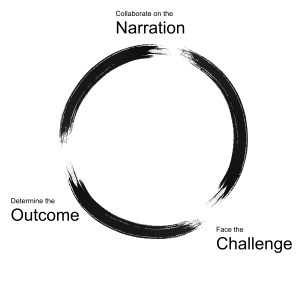
// Graphics //
Narration –> Challenge –> Outcome
Narrate what is happening -> Asses the challenge and roll the dice pool -> Determine the outcome
